
Water Tank Relining
Nationwide water tank relining for steel, concrete, GRP and underground tanks. WRAS approved materials, minimal downtime, full photographic report.
Water Tank Relining Services
Water tank relining restores a failing storage tank from the inside without removing it. For most commercial sites, it is faster, cheaper and far less disruptive than replacement.
We reline steel, concrete, GRP and underground tanks across the UK, using WRAS and DWI compliant materials that are safe for potable water.
A 6,000 litre tank is usually relined in around four hours. Larger tanks are typically completed within a single working day.
What Is Water Tank Relining?
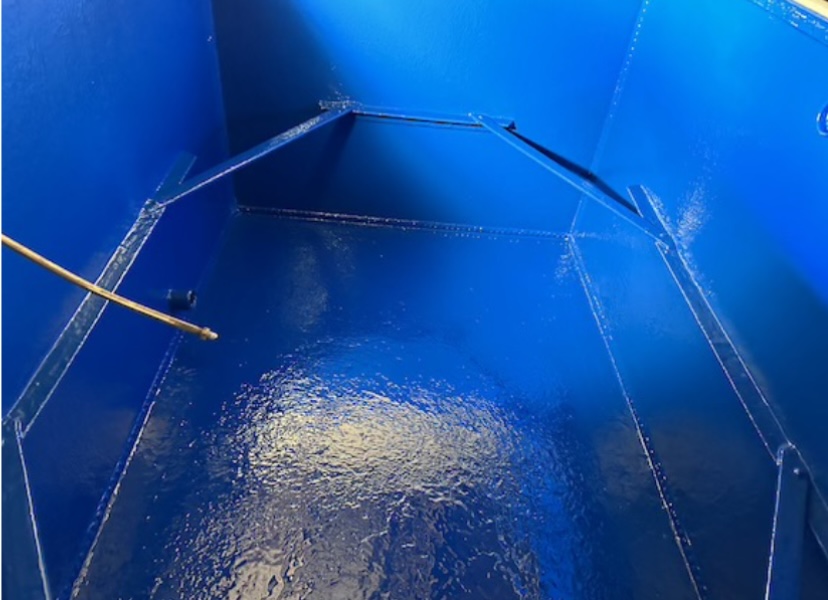
Relining fits a new, seamless internal surface inside your existing tank. The tank structure stays exactly where it is. Only the water bearing surface is replaced.
We use flexible polypropylene, welded with hot air rather than bonded with solvents. Solvent joints weaken over time and can taint stored water. Heat welded joints do not.
The result is a smooth, jointless internal finish that resists corrosion, prevents leaks, and is far easier to inspect and clean at future service intervals.
Tanks We Reline
Steel tanks. Sectional and one piece steel tanks are the most common candidates. Internal corrosion, rust scale and failed original coatings are all resolved by relining.
Concrete tanks and underground cisterns. Spalling, cracking and water loss are addressed with a lining system bonded to the prepared substrate. See underground tank and reservoir linings.
GRP and sectional tanks. Panel joints and seals fail long before the tank body does. Relining seals the whole internal envelope in one go.
Sprinkler tanks. Fire suppression tanks have their own constraints and inspection regimes. See sprinkler tank lining and relining.
Process and chemical tanks. For aggressive contents we specify accordingly, including acid tank linings and polyurethane coatings.
Why Reline Instead of Replace?
Replacement means craning the old tank out and a new one in. On most commercial sites that is the expensive part, not the tank itself.
Relining avoids all of it:
- No structural work. Plant rooms, roof access and surrounding services stay untouched.
- No crane, no road closure, no dismantling. Many tanks simply cannot be removed without taking a wall out.
- Shorter downtime. Days rather than weeks, and often a single day.
- Lower total cost. Typically a fraction of full replacement once access and reinstatement are counted.
- Longer service life. A properly specified lining extends tank life by decades.
Replacement is still the right answer sometimes, usually when the tank structure itself has failed or capacity no longer suits the building. We will tell you when that is the case.
Read our full comparison of relining versus replacement to see which applies to your site.
Our Relining Process
1. Survey. We inspect the tank, assess the internal surface, and confirm dimensions and access. Where the tank cannot be drained, we use ROV inspection instead.
2. Specification and quote. You receive a fixed quotation setting out the lining system, programme, and any associated works such as lid replacement or chlorination.
3. Isolation and preparation. The tank is drained, cleaned and prepared. Existing failed coatings are removed.
4. Lining installation. The liner is prefabricated to your tank dimensions and heat welded on site for a seamless finish.
5. Cleaning and chlorination. The tank is disinfected to standard before recommissioning. See water tank cleaning and chlorination.
6. Recommissioning and report. The system returns to service and you receive a full photographic report documenting the work.
That final report is the part clients mention most. It gives you the evidence you need for your water hygiene records without chasing anyone for it.
Compliance and Materials
All potable water linings we install use materials compliant with WRC and DWI standards and approved for contact with drinking water.
Relining supports your obligations under the HSE Approved Code of Practice L8 by removing corroded surfaces, biofilm and sediment traps that make temperature and bacterial control harder to maintain.
Material approvals can be checked through the Water Regulations Advisory Scheme.
How Much Does Water Tank Relining Cost?
Cost depends on capacity, tank material, access, the condition of the existing surface, and whether works need to run out of hours.
As a guide, relining typically costs a fraction of full tank replacement once removal, craneage and reinstatement are taken into account.
Send us your tank details for a fixed quotation.
Who We Work With
We deliver relining programmes for NHS trusts, universities, hotel groups, managing agents, facilities management providers and industrial operators nationwide.
Clients include Morgan Sindall Property Services, Veolia, CBRE, Knight Frank, Travelodge and the University of Nottingham.
Frequently Asked Questions
How Long Does Relining Take?
Water Tank Relining can be completed quickly and efficiently. While replacing a tank may require days or even weeks of work, relining a tank can often be completed in just a few days, depending on the size and condition of the tank. This can minimize the disruption to the home or business and allow the tank to be returned to service more quickly.
Is it compliant with regulations?
Absolutely! Echo Square ensures that all regulations from WRAS and HSE are strictly followed, especially those related to potable water storage. Our specialist solvent free polyurethane tank coating is WRAS approved and is non-toxic. For full regulatory guidance on water hygiene in buildings, refer to HSE.gov.uk and the UK Government water safety guidelines.
Do you offer guarantees?
Yes we do. To back up our confidence in our expert storage tank reline solution we offer up to 15 years guarantee on all tank relining projects. The guarantee duration will be made clear at the time of quotation and provided in writing.
Will my site suffer downtime?
Tank relines can be carried out during “out of hours” working times & over weekends, often water tanks and process vessels are separated into two separate compartments, which ensure operatives are able to work on one compartment at a time, therefore keeping one compartment online at all times and ensuring the water system down services do not require isolating.
Which areas do you cover?
Our water tank relining teams are set up to provide fast and dependable service throughout England, Scotland, Wales and both Northern Ireland and the Republic of Ireland. As part of one of the nation’s largest and most trusted water system suppliers we are backed by teams offering water tank relining in London, Kent, Manchester, Newcastle, Glasgow, Edinburgh, Southampton, South East of England, Dublin & Belfast.
Can’t we just replace the tank?
Carrying out full water tank replacements can be very costly and time consuming therefore water tank relining can be a far more cost-effective alternative which ensures far less disruption is caused to a building’s services and occupants.
What is Legionella?
Legionella is a harmful bacteria which can affect your lungs and develop into Legionnaires’ Disease. This predominately affects people with a suppressed immune system, smokers and those aged over 50. It is a form of pneumonia which can be fatal if contracted via an aerosol which is subsequently inhaled by the victim, often via showers, or misting systems.
How much does water tank relining cost?
Water tank relining costs depend on the tank’s size, material, condition and accessibility. Typically, relining is significantly more cost-effective than full tank replacement. Echo Square provides free no-obligation quotations — most clients receive a quote within 24 hours of enquiry. Contact us for an accurate assessment of your specific project.
What types of water tanks can be relined?
Echo Square’s ES 988 DWPU coating is suitable for concrete water tanks, galvanised steel tanks, GRP (glass reinforced plastic) tanks, bespoke process vessels and cooling towers. For tanks unsuitable for polyurethane coating — such as certain Franklin Hodge corrugated tanks and fire sprinkler water tanks — we also supply and install butyl and EPDM sheet liners.